Saturday, November 5, 2022

Part 4: Assignment 3

The process of educational progression in the United States was only existent because of the ever lasting economic competition between other countries. The realization of success from other countries posed as a harsh reality for politicians. They were concerned for the United States, but could not understand why the country was "losing" the economic battle. They searched and grasped at any solution to be the reason for the country's faults and weak links. Eventually, the answer came to be that the educational system was failing the people of the United States. Politicians noticed that other countries were producing and graduating with such "highly skilled workers", and their knowledge and success was assisting their respective country in their economic successes (Mondale 175). With that consideration in mind, politicians then analyzed the status of the educational system that existed at their time and expense in the United States: in America, "teachers talked most of the time, children listened, read the textbooks, and recited answers to the teachers" (Mondale 175). But how much of this information was actually being retained and used in the daily lives of these children? After much observation, politicians concluded that the United States was severely lacking in knowledge and educational standards and began to "[crack] down on students", making sure that "students were meeting these new standards" (Mondale 187). The politicians wanted to change the way the students were educated in order to take a lead in the competition of education. This period of time became known as the "learning crisis" because of "low standards, lack of purpose, and a failure to strive for excellence" (Mondale 184). Now, for the first time in the history of education, politicians noticed the numbers of students rise in attendance. The burst in students attending school in a quantitative manner conflicted with the lack of quality of the American education. Schools did not consider “more than 71 percent of seventeen-year-olds [graduating] from high school”, not to mention that many students attending to begin with. This created major chaos in the schools with one goal to resolve it: “‘restore quality to education by increasing competition and by strengthening parental choice and local control’” (Mondale 184). Now with students attending school and benefitting from the increase in educational quality, the economic reputation of the United States was comparable to other countries, displaying a fair competition in the battle of education.
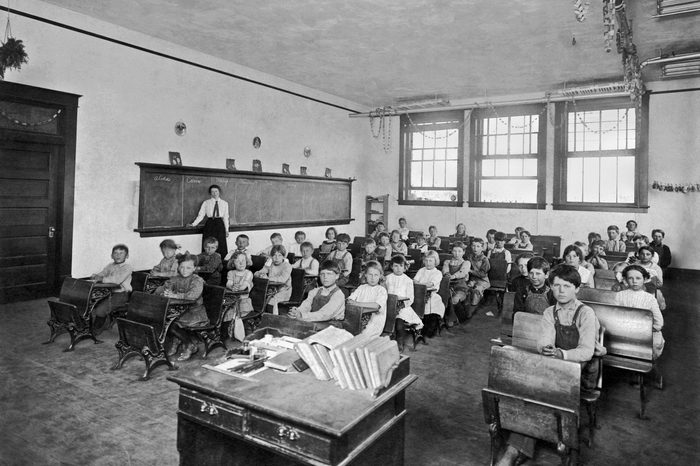
This Is What School Was Like 100 Years Ago | Reader's Digest

Personally, I find it rather interesting to learn that because of the blame placed randomly on the educational system in the United States for the faults of our economic status, our educational quality had no choice but to better itself. If the blame had been put on any other functioning aspect of our country's society, that too would have benefited from the consequences, and would have therefore adjusted the economic status to thrive. I cannot say that our education in the United States is perfect where it is, but because of the learning crisis and economic boom, our country has improved significantly in education.

Saturday, October 22, 2022

Part 3: Assignment 3

I can see how separate but equal would be a viable option in education in today's society. But not through the concept of racial inequality that has been previously exploited in our history. In today's terms, separate but equal could be displayed in the context of grade levels: each student, no matter their level, is still an equal participating member within their school (not one student is superior or better than the other). Keeping students separate within respective grade levels of education encourages confinement within curriculum based learning. Each level has objectives to which they should achieve before they can move onto the next level of education. However, I'm not sure separate but equal will never be true in the context of race and education. I cannot even say that together and equal will be true. Once the trend of segregation and superiority begins, the likelihood of releasing that fad is not an easy feat. Because our country has practiced white supremacy for centuries, the stigma of racial superiority still lingers in the society we live in, no matter how many years later. Although the challenge to defeat this stigma is very much possible, it would take the adaptation of the minds of billions of people, not of whom all think alike and/or are willing to do so. Even in the 1950's, parents "went to the school board, they talked to the school board, they did everything that they could in order to get [the school board] to understand", so that all children could be deserving of equal and honest education (Mondale 135). However, the school board responded with a severe lack of urgency and claimed that although schools were separate, they were treated equally. It was obvious to the public, then and now, that the separation between schools was not even close to similar, not to mention equal. The process of desegregation was in desperate need to make its appearance, not just for "facilities and resources and the constitutional and moral reasons", but for the learning equality as well (Mondale 137). The schools and resources provided for students of color were unkempt, affecting the quality of education given to them. Lack of supplies cannot excuse the lack of education, for it only hinders it more, creating an environment with inequality in communities.

I think the education of any and all mistakes, no matter what context they are made in, is the only way to truly understand and recover from that mistake. It takes learning of said mistake to recognize where one as an individual, or where a society as a community went wrong. It also takes the recognition of one wrong mistake and the realization that the recovery could be applicable in other contexts. Learning from one's mistake is one thing. Realizing that another could be prevented takes critical thinking. The remembrance of prior mistakes to avoid another worldly catastrophe can only benefit the future. Because this course provides education on past mistakes, in this case racial and educational inequalities, I think it could be beneficial to other members of our society to take this course.

https://www.youtube.com/watch?v=9lsDJnlJqoY 

Saturday, October 1, 2022

Part 2: Assignment 3

Educating children in the 1900-1950's era was a complicated process. Many people saw the benefits of it; others could only see to the Americanization of cultures. The favoritism to American culture became the main focus when teaching children of all backgrounds and the colonization of students posed as a big issue in school systems. Immigrants' cultures were not valued, rather tossed aside as Christian holidays were praised and celebrated. Most schools "required that students recite passages from the Bible, or the Lord's Prayer" (Mondale 96). Even language learning was strictly English only. When schools tried to incorporate other languages in their curriculum, the idea was shot down. It was noted that "all of the teaching took place in English", when most of the students combined in one classroom "'spoke eight or ten or fifteen different languages'" (Mondale 94). Schools even honored and "emphasized American heroes and anthems" (Mondale 95). Unfortunately, not everyone could see this suppression, for they focused on the unity and aide that schools brought to their community. As far as educating poor students, schools were there to help children in need of certain facilities: "part of the reason they had swimming pools in the school was so kids would have a bath", for not all students had the ability to clean themselves before they begin the day's work (Mondale 90). People became so blind by the good that schools provided for students that eventually, the bad was forgotten. They only noticed that "the Gary schools were open...to serve the entire community" (Mondale 91), not that the Gary schools were crafting students to become good workers to provide for the economic status of the country. The assimilation of children into American culture helped merge students into one, unified educational class, but also masked other cultures and representations, creating a shallow, unthoughtful system.


The intelligence quotient, or I.Q. tests became the sole, deciding factor of how successful a student would become. The I.Q. test was used to "have a better understanding of each individual's ability or capacity, and create a kind of social efficiency for the country", to build a sort of "Utopia" (Mondale 101). It determines a child's path from the moment they take the I.Q. test, through to their high school education, to see if they will move on to secondary or college education, how successful their career will be, and more. The issue with the I.Q. test is that the questions are questionable - "TRUE OR FALSE: A large man is always braver than a small one" (Mondale 102). One cannot base another's future on the outcome of a test, particularly when it favors the "quality of people by ethnicity, by race, by class" (Mondale 101). To assume that children's mental capacity can be analyzed by a sequence of questions is only to assume the knowledge they know at that point in time, without taking into account of their future educational expertise. Plus, given the now known information that students learn differently than other students, different learning and/or testing types should be considered within the I.Q. tests, yet it was not. Soon enough, the publicity of I.Q. tests "'got a huge pickup in the media and really helped to popularize the idea of I.Q. as the crucial human quality'" (Mondale 102). With a good enough score, "'[America] will come to your door, they will give you a scholarship and they will put you on the road to success'" (Mondale 103). Which is fantastic for those who are fortunate enough to receive such credit. But for those who are not, they will not benefit from the school system.

https://www.youtube.com/watch?v=Qdzz0sEaiT4
*begin at 5:26-9:22, jump to 11:32-12:50*

Works Cited

“The (Racist) History of the I.Q. Test !!!” YouTube, YouTube, 24 Sept. 2021, https://www.youtube.com/watch?v=Qdzz0sEaiT4. 

Streep, Meryl, et al. School: The Story of American Public Education. Beacon Press, 2006. 

Sunday, September 25, 2022

Part I: Assignment 3

Public education shows unity in the United States through the solidarity of social classes and the will to improve social outcomes. By a more forceful technique than not, the unity exists simply because "common schools would not truly serve as a unifying force if private schools drew off substantial numbers of students, resources, and parental support from the most advantaged groups" (Kober 3). This was believed to be the only way to succeed required enough children across all social classes into a system of common schooling. Although not through an organic process, this inclusivity bonds children across the country. With the encouragement for all students to learn at public schools, "the path toward providing universal access to free education was gradual" (Kober 4). Despite the task being slow and unsteady at first, more states accepted the responsibility to include universal free education in their constitutions. With the new moral obligation to hold the standard of public education, the government took on the crucial role to include students from low-minority income families, students with disabilities, students with limited knowledge and application of the English language, and so on. The federal government ensured that "educational equity" would be promoted and provided (Kober 6). Not only was the federal government approaching this situation hand-on, so was Horace Mann. He rode by "horseback from district to district and [reviewed] the actual physical facility" (Mondale 27). Over the course of six years and in one thousand schools, "Mann found a system built on inequity" (Mondale 27). The conditions of schools were unsafe, not to mention the curriculum from which students were learning from was "outdated and irrelevant" (Mondale 28). This unity opens the eyes to the harsh separations of the country, providing hindsight for the future in order to achieve a more equitable school system.

In terms of dividing the country, the most obvious answer would be segregation. Not only between race, but between gender, immigrants, disabled, religion, economic status, etc. Having been underserved for many millennia at the start of our nation, non-white groups "were often underserved or educated in separate schools, by law or by custom" (Kober 5). They redefined the achievement of education to "tie the quest for freedom and the quest for education and excellence together" (Mondale 41-42). Investigation from the school committee to integrate schools based on race took much longer than any other integration process. The committee vowed that "in the case of colored children, we maintain that their peculiar physical, mental, and moral structure requires an educational treatment different from that of white children" (Mondale 43-44). The dismissal of black students based on the color of their skin seemed to have been brought about by the fear that the "competition" against white children would be unmatched, resulting in "sneers, insults, assaults, and jeers" (Mondale 44). Not only was an entire race neglected from the inclusion of public education, but also an entire gender. The idea of "female geniuses" was not even considered a possibility in the mind of Thomas Jefferson (Mondale 24). He concluded that there would be just three years of schooling to teach women how live a married and motherly life. Within the school, girls were taught to sew, "but of course underneath that material would be textbooks" (Mondale 24). Even when public schools opened up for women, "they were sometimes taught a different curriculum from boys and had fewer opportunities for secondary or higher education" (Kober 5). At this point, the only acceptable classification left to become educated were white men. Yet, even within that class, the question of religion raised a big question. Because of the growing number of immigrants, many of the public schools did not teach their religion. With hopes to fight for the inclusion of Catholicism - eventually encouraging others to fight for their own religion - John Hughes challenged the beliefs of Horace Mann. He proclaimed, "We are unwilling to pay taxes for the purpose of destroying our religion in the minds of our children" (Mondale 33). People of other religions felt unsafe attending schools with which their religion was not just unlearned, but disgraced and destroyed by the hands of others.

Currently, school has shaped and defined the lives of the American public based solely on hindsight and accountability. We have learned from our past and bettered ourselves from it. The changes made to our public school system has only helped our society grow, and because of that, we can admit the mistakes we have made. For they have only encouraged a brighter, more equitable, opportunity filled future. In my experience, public education has taught me to be responsible for my own actions, teaching me obedience within my individuality and independence. I have learned from not only the past of American history, but also my past, advancing from grade to grade and excelling at each level.


Works Cited

Kober, Nancy. “History and Evolution of Public Education in the US - Eric.” History and Evolution of Public Education, https://files.eric.ed.gov/fulltext/ED606970.pdf. 

Streep, Meryl, et al. School: The Story of American Public Education. Beacon Press, 2006. 

Thursday, September 1, 2022

Blog Assignment #1

My earliest experience of becoming literate was reading my Little Golden Book Classics, such as The Poky Little Puppy, Scuffy the Tugboat, The Little Red Caboose, and The Shy Little Kitten. I remember my older brother helping me; we often read under the coffee table wrapped in my ballerina fairy blanket. He definitely motivated me to read like a "big kid" because he was older than me and I had to make him proud! I was a bit discouraged at first, but soon found a natural talent for picking up the words. I was also very apt to put my finger under a difficult word and sound out each letter. I would say this technique significantly helped my development. When I felt disappointed or frustrated with a word or my skill, I knew to take a deep breath and slow down, breaking the word apart either letter by letter or by syllable. My mother first taught me this method very early, for she didn't want me to fall behind in my subjects at school. Eventually, I learned the technique with my classmates in school. I did not fully recognize and process my reading abilities until I picked up the first Harry Potter book. Quite prematurely, to say the least. I was in the third grade when I began reading the series. I remember wanting to read the book so bad because all of my older siblings had already gone through most of the books, if not the whole series, and I wanted to fit in, too! During my elementary education, I enjoyed keeping track of our reading levels throughout our years. I always felt so accomplished to know that I moved up reading levels! Something that frustrated me when I was a little kid was learning proper grammar. Now, I appreciate the correct placement of punctuation and word order. I cannot seem to understand how people are not able to form a simple sentence in the correct sequence. My parents were and still are role models to me in the education world. As a literate person today, I often feel discouraged by reading. I know my progression has not been a consistent climb upwards and my knowledge has plateaued quite a but. I do blame myself for the lack of books I have read since having assigned reading books in my upper education. Now, I have an even more difficult time trying to find a book I am interested in. The first couple of pages take a significant amount of time to digest and comprehend, and by the time I hit the 30 minute mark of reading, I give up. I have recently picked up reading again this summer and made my way through two, large sized books. They were both about dance, which made it easier to read because I was more interested, but I was proud that I had encouraged myself to pick up a book instead of someone requiring it to me. In current times, my Artistic Director at school continues to inspire me through her literacy. I love to hear her talk about all topics involving dance. The way she speaks is so eloquent and always manages to make me feel apart of something so much bigger than all of us. Her passion combined with her intensity is so enticing and elaborate in the most illustrative and creative ways possible. I love to listen to her tangents because they are so empowering and fulfilling.

Saturday, August 27, 2022

Introduction

Hi! My name is Kathryn Mayer. I am a full-time third year student at the Joffrey Ballet School, as well as a part-time student at NJCU. I am earning my BFA in Music, Dance, and Theater through NJCU and will be receiving a certificate of completion at the end of my fourth year from the Joffrey Ballet School. My interests clearly reside in dance performance (I've been dancing since the age of two!) and more recently, the history and evolution of dance. Since the harsh reality of a dancer's career is very short, I've started the process of advancing myself as a person, too. Some other hobbies I have come to appreciate are writing/journaling, cooking and baking, and spending time with my friends. I also thoroughly enjoy the Marvel Cinematic Universe, french toast, chapstick, and shopping. I am taking this class because I would like to learn about the public education system, particularly, the development of the historical process from beginning to current years. Both of my parents were teachers at public schools, so this topic is also somewhat familiar to me. I'm hoping to add more knowledge to the small list I already have by taking this course!


Capstone Project: Post 5

June 27, 1991 Dear Journal,     Here's to the retirement of the good work I have put forward to help the people of my community. From my...